
Double-Chin Surgery Oxfordshire – Is It Worth the Risk?
A double chin can develop for several reasons, and it isn’t always related to weight. For some people, it’s a pocket of fat beneath the chin. For others, loose skin, genetics, or the natural shape of the jaw and neck may contribute.
If you’re unhappy with the appearance of your chin or jawline, you might have considered surgery. Liposuction and neck lift procedures are among the surgical options available, but they involve different techniques, recovery periods and potential complications.
If you’d rather avoid surgery, treatments such as HIFU and fat freezing may be worth exploring. They work differently and won’t suit everyone. At LA LIPO, we want you to have a clear picture of what’s involved, including the possible risks and what each treatment can realistically achieve, before making your decision. This guide covers double chin surgery, the available alternatives, and the factors worth considering when exploring your options.
Why Do We Get a Double Chin?
You don’t have to be overweight to have a double chin. Some people have always had a little extra fullness beneath their jaw, while others notice it developing as they get older. Several things can cause this.
- Genetics: If double chins run in your family, you may be more likely to carry extra fat beneath your chin, even if you’re otherwise slim.
- Weight changes: Increased body fat may contribute to fullness around the chin and neck.
- Ageing: Skin gradually loses elasticity, which can change the appearance of the jawline.
- Skin laxity: Loose skin may create the appearance of a double chin even when very little excess fat is present.
- Facial structure: The natural position and shape of the chin and jaw can influence how prominent the area beneath the chin appears.
Understanding what contributes to the appearance of a double chin matters because different treatments address different concerns.
For example, a procedure designed to reduce localised fat may have limited benefit if loose skin is the main issue.
What Is Double Chin Surgery?
Double chin surgery is a general term for surgical procedures intended to change the appearance of the area beneath the chin.
The best procedure depends on whether the concern involves excess fat, loose skin, underlying muscles, or a combination of factors.
Two commonly discussed options are liposuction and neck lift surgery.
1. Chin Liposuction
Liposuction involves removing fat through a small tube called a cannula inserted beneath the skin.
When performed around the chin and neck, the procedure aims to reduce localised fat deposits and reshape the area.
Liposuction may be considered for people with excess submental fat and sufficient skin elasticity.
However, removing fat doesn’t necessarily tighten loose skin. In some cases, skin laxity may become more noticeable following fat removal.
Possible risks include:
- Swelling, bruising and discomfort
- Infection or bleeding
- Changes in skin sensation
- Uneven contours or asymmetry
- Fluid accumulation
- Scarring
- Complications associated with anaesthesia
Recovery varies depending on the procedure’s extent and the person’s general health.
Swelling may take several weeks or longer to settle, and the final appearance may not be apparent immediately.
2. Neck Lift Surgery
A neck lift is a surgical procedure that may involve removing excess skin, repositioning tissues or tightening underlying muscles.
Unlike liposuction, which primarily targets fat, a neck lift is generally considered when skin laxity or changes in the underlying neck structures are contributing to the appearance of the area.
In some cases, a surgeon may recommend more than one procedure to address different concerns around the chin and neck. This will depend on the person’s individual needs and what they hope to achieve.
As with any surgery, there are risks to be aware of, including:
- Bleeding or an infection developing after surgery
- Scars that may remain visible once the skin has healed
- Wounds taking longer than expected to heal
- Numbness, tingling or changes in how the skin feels around the treated area
- Nerve injury
- Asymmetry or an unsatisfactory cosmetic result
- Anaesthetic complications
A neck lift typically involves a more substantial recovery period than many non-surgical cosmetic procedures.
Anyone considering surgery should discuss the expected outcome, risks, recovery and alternatives with an appropriately qualified surgical specialist.
Is Double Chin Surgery Worth Considering?
There’s no single answer to this question.
Surgery may offer more substantial changes than some non-surgical procedures, particularly when significant excess skin or fat is present.
However, it also involves surgical risks, recovery time and financial considerations.
Before deciding, it can help to think about:
- Whether excess fat, loose skin or facial structure is the main concern
- The degree of change you hope to achieve
- Your general health and medical history
- The recovery time you can reasonably accommodate.
- The possibility of complications or further procedures
- Whether your expectations are realistic
Surgery isn’t necessarily the right choice for everyone, but neither should non-surgical treatments be assumed to provide equivalent results.
A qualified surgical consultation can help establish which options may be appropriate.
Can You Reduce a Double Chin Oxfordshire Without Surgery?
Some people prefer to explore non-surgical treatments before considering an operation.
These procedures generally involve less extensive intervention than surgery, but that doesn’t mean they’re risk-free or suitable for every concern.
At LA LIPO, we offer non-surgical cosmetic treatments in clients’ homes, subject to suitability and treatment availability.
Options we may discuss include HIFU and cryolipolysis, commonly known as fat freezing.
The choice of treatment depends on the area being assessed, the equipment used and the individual’s circumstances.
HIFU for the Chin and Jawline
High-Intensity Focused Ultrasound, or HIFU, uses focused ultrasound energy to heat targeted tissue beneath the skin.
It is used in cosmetic procedures intended to address certain concerns relating to skin firmness and appearance.
HIFU is sometimes marketed for the chin, jawline and neck. However, evidence supporting cosmetic outcomes varies by device, treatment settings, and anatomical area.
Don’t assume HIFU will remove a double chin or match the results of liposuction or a neck lift.
What Can You Expect From HIFU?
Some people may notice changes in the appearance of treated skin over time, while others may experience little visible improvement. How your skin responds to HIFU can depend on its condition, where you’re having treatment, and the equipment used.
It’s also worth knowing that HIFU has its limits. It won’t remove large amounts of loose skin or give you the same level of change that surgery may achieve.
Are There Risks With HIFU?
Although HIFU does not involve surgical incisions, it delivers energy into tissue and can cause adverse effects.
Some of the side effects and complications to be aware of include:
- Discomfort or tenderness in the treated area.
- Skin that looks red or feels swollen afterwards
- Temporary numbness, tingling or changes in skin sensitivity
- Burns or blisters caused by heat affecting the skin
- Irritation or injury to nearby nerves
- Changes to the appearance of the treated tissue, which may not always resolve completely
Some complications may be prolonged or require medical attention.
A practitioner should explain the risks associated with the specific device and treatment area before proceeding.
Fat Freezing for a Double Chin Oxfordshire
Cryolipolysis, often called fat freezing, uses controlled cooling to target fat tissue.
It is used in cosmetic procedures intended to reduce certain localised fat deposits.
However, not every fat-freezing device is designed or approved for use beneath the chin.
The submental area requires particular consideration because of its anatomy and proximity to sensitive structures.
Consider treatment only when the equipment is intended for that area, the practitioner is appropriately trained, and an individual assessment confirms suitability.
Does Fat Freezing Tighten Loose Skin?
Fat freezing primarily targets fat tissue, not excess skin.
It should not be presented as a reliable way to tighten loose skin or lift the neck.
Someone whose main concern is skin laxity may not be a suitable candidate.
Are There Any Risks With Fat Freezing Oxfordshire?
Fat freezing doesn’t involve surgery, but that doesn’t mean it’s completely risk-free. Some people experience mild reactions after treatment, while others may develop more troublesome side effects or complications.
Things to be aware of include:
- Soreness or tenderness that may continue after the appointment
- Numbness, tingling or changes in how the skin feels
- Increased sensitivity or discomfort when touching the area
- Uneven results that can leave the treated area looking irregular
- Skin damage caused by exposure to very low temperatures
- A rare complication called paradoxical adipose hyperplasia, where the treated fat becomes larger rather than smaller
Paradoxical adipose hyperplasia is an uncommon but significant complication in which the treated fat tissue increases in size rather than reducing. It may require surgical correction.
Cryolipolysis is not a weight-loss treatment, and a specific fat reduction cannot be guaranteed.
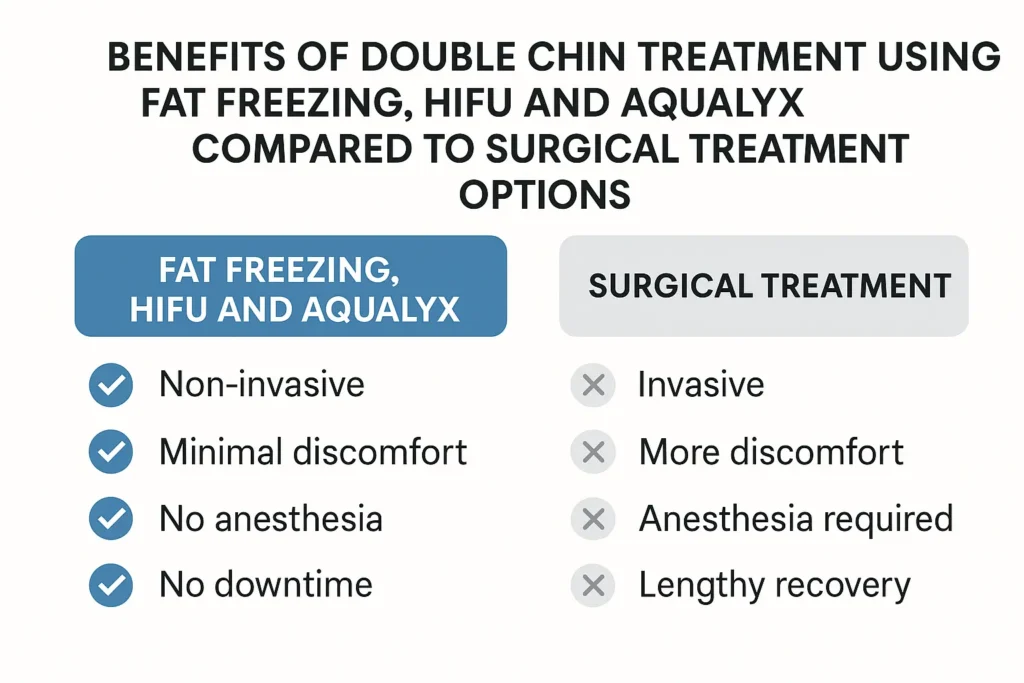
Double Chin Surgery vs Non-Surgical Treatments Oxfordshire: What’s the Difference?
Both surgical and non-surgical procedures have advantages and limitations. Understanding these differences can help you ask more informed questions during a consultation.
| Main purpose | May remove fat, excess skin or reposition tissue | Depends on technology; may target localised fat or skin appearance |
| Invasiveness | Requires surgical intervention | Usually avoids surgical incisions, although energy is delivered into tissue |
| Recovery | Often involves more extensive recovery | May involve less downtime, but reactions and complications can occur |
| Potential results | May produce more substantial structural changes | Changes may be more limited or less predictable |
| Risks | Surgical, anaesthetic and wound-healing complications | Device-specific risks, including tissue injury |
| Suitability | Requires surgical assessment | Requires assessment and an appropriate device |
Neither approach is universally safer or more effective.
The appropriate option depends on the person’s anatomy, health, treatment goals and willingness to accept the associated risks.
How Long Does It Take to See Results?
The timescale depends on the procedure.
Following surgery, swelling and healing can affect the appearance of the treated area for weeks or months.
With HIFU, visible changes may develop gradually, and some people may not notice a meaningful improvement.
Cryolipolysis also involves a gradual biological response, and changes, when they occur, are generally assessed over weeks to months.
These are broad descriptions rather than guaranteed recovery or results timelines.
Your practitioner should explain what is known about the specific treatment being considered and how the outcome will be assessed.
Can HIFU and Fat Freezing Be Combined?
Different cosmetic technologies are sometimes discussed together because they target different tissue characteristics.
For example, cryolipolysis is intended to affect localised fat tissue, while HIFU uses focused ultrasound energy and may be used for certain skin-related concerns.
However, this does not establish that combining the procedures produces better results or that the combination is appropriate for the area beneath the chin.
Evidence for individual technologies cannot automatically be used to support claims about combined treatments.
Any proposed combination requires careful consideration of device instructions, the anatomical area, possible interactions, treatment intervals and individual risks.
Who Might Not Be Suitable for Non-Surgical Double Chin Treatments Oxfordshire?
Not everyone is an appropriate candidate for energy-based cosmetic procedures.
Before proceeding with treatment, your practitioner will need to check whether anything in your medical history could make it unsuitable or increase the risk of complications.
Things they’ll need to know about include:
- Whether you’re pregnant or breastfeeding
- Any existing health conditions that could affect your treatment
- Skin infections, irritation or inflammation in the area you want treated
- Previous surgery or cosmetic procedures around your chin or neck
- Medical implants or metal in or near the treatment area
- Problems with skin sensitivity, circulation or healing
- Previous difficulties with scarring or wounds healing properly
- Any medication you’re currently taking that could affect treatment safety.
These are just some of the things your practitioner may ask about. Each treatment has its own safety requirements, so what suits one person may not suit another. The required checks will also depend on the equipment used.
A full consultation should include relevant medical history, an examination of the proposed treatment area and a discussion of the expected benefits and possible complications.
If the cause of swelling or fullness beneath the chin is uncertain, medical assessment may be needed before considering cosmetic treatment.
Frequently Asked Questions About Double Chin Surgery
1. Can a double chin be removed without surgery?
Some non-surgical treatments can address localised fat or skin appearance, but they cannot reliably match the results of surgery. Whether a treatment is appropriate depends on the cause of the double chin and the device being used.
2. Is double chin liposuction permanent?
Liposuction removes fat cells from the treated area, but the chin’s appearance can still change with weight fluctuations, ageing, and skin laxity. A permanent cosmetic appearance cannot be guaranteed.
3. Is HIFU better than double chin surgery?
Neither treatment is automatically better. Surgery and HIFU involve different techniques and may address different concerns. HIFU should not be considered a direct replacement for liposuction or a neck lift.
4. Does double chin surgery leave scars?
Surgical procedures involve incisions and can leave scars. Their location and visibility depend on the procedure, surgical technique and individual healing response.
5. Can fat freezing be used under the chin?
Certain cryolipolysis devices are designed for submental fat, but others are not. Suitability depends on the specific device, its instructions for use and an individual assessment.
6. Can exercise get rid of a double chin?
Exercise and changes in body weight may affect overall body fat, but you can’t choose exactly where your body loses fat. A double chin caused mainly by genetics, skin laxity or facial structure may not respond significantly to weight loss.
7. Is non-surgical double chin treatment painful?
Some people experience discomfort during HIFU or cryolipolysis. Pain, tenderness, swelling and changes in sensation can also occur afterwards. The experience varies by procedure and individual response.
8. Is fat freezing safer than liposuction?
Fat freezing avoids surgical incisions and general anaesthesia, but it carries its own risks, including tissue injury and paradoxical adipose hyperplasia. The safety of either procedure depends on individual circumstances, practitioner competence and the treatment being performed.
9. What should I consider before booking double chin treatment?
Start by understanding what is causing the appearance of the area beneath your chin. Ask about the treatment’s intended purpose, supporting evidence, possible results, risks, recovery, contraindications and alternative options.
Exploring Your Double Chin Treatment Options With LA LIPO
If you’re considering treatment for the appearance of a double chin, it’s worth finding out whether excess fat, skin laxity or another factor is contributing to your concern.
At LA LIPO, we provide selected non-surgical cosmetic treatments in the comfort of clients’ homes, subject to availability and suitability.
Our consultation process lets you discuss your concerns, relevant medical history, the available equipment, and the potential benefits and limitations of treatment.
Not every concern can be addressed through non-surgical procedures, and we cannot guarantee a particular cosmetic outcome.
Contact LA LIPO to discuss the available options and whether an assessment for non-surgical treatment may be appropriate.
Important information: This article is intended for general information and does not replace individual medical advice. Surgical and non-surgical cosmetic procedures carry risks, and results vary. HIFU and cryolipolysis are not suitable for everyone, and treatment claims must be supported by evidence for the specific device and area being treated. If you are considering surgery, seek advice from an appropriately qualified surgical professional. Unexplained swelling, lumps or other changes beneath the chin should be medically assessed rather than assumed to be cosmetic.